
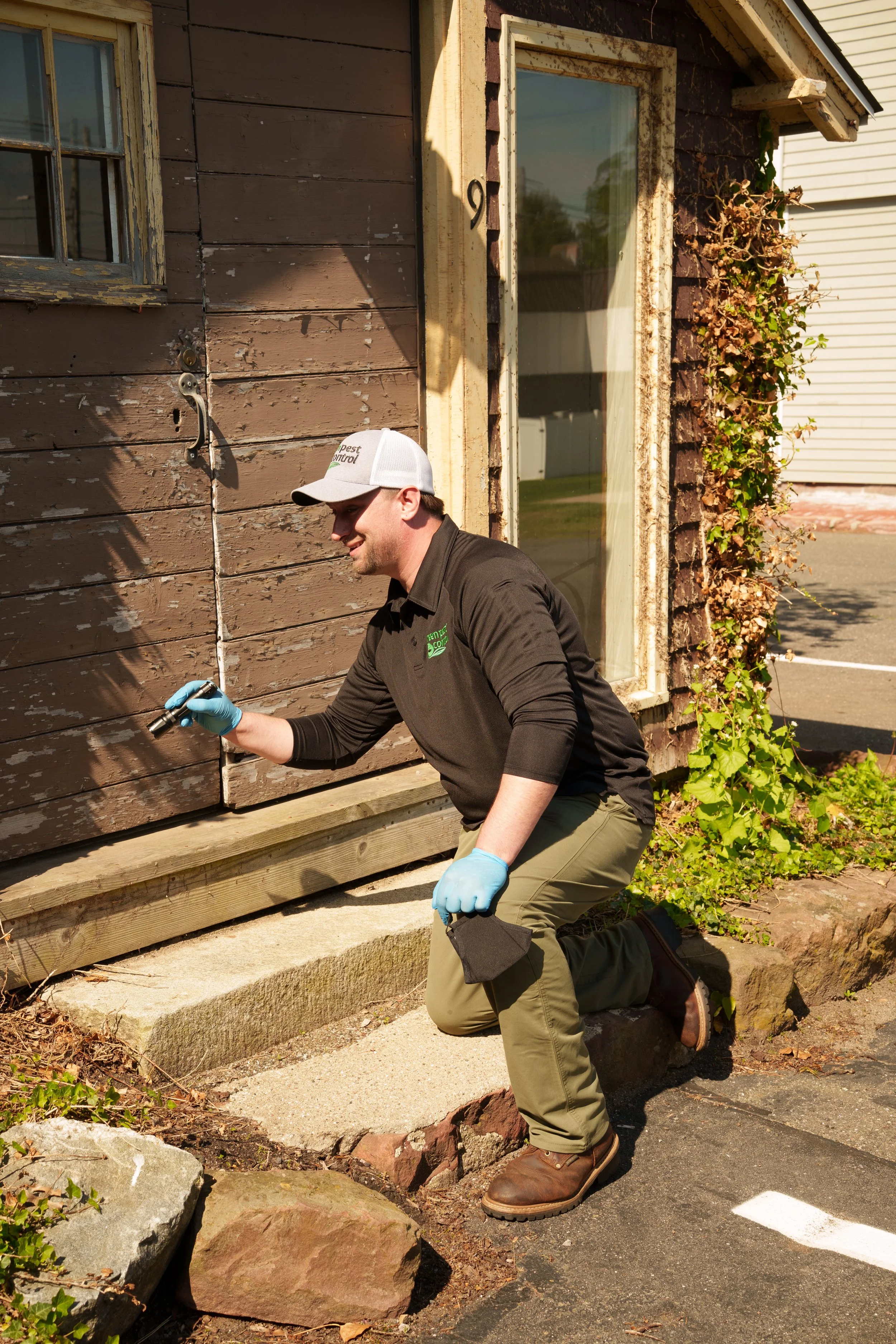
Rat Control in Avon, CT
A rat does not dig a burrow if it can find one ready-made, and a stacked retaining wall is a structure full of ready-made burrows, built for entirely good reasons.
Rat or mouse? Send an image of the droppings, and we will settle it before anyone schedules anything.
Three Habits That Make Rats Difficult
They are careful. Anything new in an established run is studied before it's touched, sometimes for weeks, which is a common reason a homeowner's efforts stall.
They range. A rat works a few hundred yards from where it sleeps, so the nest, the food, and the sightings are often in different places and occasionally on different properties.
They climb and gnaw hard. Roofline access via a tree or a utility line is ordinary, and anything sealed to a mouse standard gets opened again.

Stacked Walls Are Pre-Built Burrow Systems
If your lot slopes, the landscaping often addresses that by terracing: segmental block walls, dry-laid stone, timber cribbing, and stepped beds, each holding back a couple of feet at a time. On the ridge side of Avon we see a great deal of it.
Structurally, all of those are the same thing to a rat. Behind the face of a properly built wall is drainage stone, and behind that is backfill. That gravel layer is loose; it drains, stays looser, and drains better than the surrounding soil, and it is completely concealed. A rat that finds a gap at the end of a wall or between two blocks is not digging a burrow; it is moving into one that already exists, with drainage, insulation and a roof.
The tell is usually at the ends and the base. Look where a wall meets a step, a corner or a planting bed, and at the joint between the lowest course and the ground. Smooth, worn openings with a little fresh soil fanned out below them, and a polished run leading away through the mulch, are what an active system looks like. On a terraced property, those openings are often at multiple levels.
Which is why the evaluation here walks the hardscape rather than the house. A house with a rat problem and no burrows anywhere on the property is receiving traffic from elsewhere. A house with a terraced garden and three active openings in the walls indicates a resident population, and those two situations receive different plans and different prices.

What We Check
Signs it is rats
- Burrow openings at the ends or the base of a retaining wall, with soil fanned out below
- A polished, worn run leading away through mulch or ground cover
- Capsule-shaped droppings, several times the size of a mouse's
- Greasy rub marks along block, stone or a fence rail
- A sighting in daylight, which usually means the system has outgrown its cover
Hardscape and planting worth a look
- The ends and lowest course of every retaining wall
- Under steps, landings and any raised patio with a void beneath
- Deep mulch beds against the foundation
- Dense evergreen planting that has grown into a continuous run
- Irrigation valve boxes and utility pits
How the Work Runs
A real person answers
No phone tree and nobody on commission.
A free evaluation of the grounds
Free wherever we serve, confirmed the day before and again twenty minutes out. On a landscaped property, that walk takes longer, and it should.
We find the burrow systems
Where they are, how many, and at which levels, which tells us how established this is.
We build the plan around their caution
Placement and timing carry a rat job. Rushing it is what extends it.
Numbers down, then openings closed
Sealing an active population inside makes things worse, so the order is fixed.
We keep the landscaping intact
Nothing here requires taking your garden apart. The work goes where the runs are.
Decks and Raised Patios Do the Same Thing
A retaining wall is the clearest version of this, and it is not the only one. Anything built to hold a grade or to sit above it creates a void underneath, and voids are what rats are shopping for.
A deck on posts with skirting around it is a dry, roofed, undisturbed space with a soil floor. A raised patio or a landing built over fill is the same thing with a harder lid. A garden shed on skids sits a few inches off the ground for exactly the reason that makes it attractive. None of those are mistakes, and all of them want checking.
The useful habit is to look at the perimeter of each once a season: the skirt line, the corners and anywhere the ground has washed away underneath. Worn mouths with fresh soil fanned out below are the tell.
Avon Rat Questions
Do we have to pull the wall apart?
Our landscaping is a real investment. Will this damage it?
We have never had rats, and suddenly we do. What changed?
Are they dangerous to the family or the dog?
Will it take more than one visit?
How much does rat control cost in Avon?
Reviews From Your Neighbors
Why Avon Calls Us
- Our Farmington office is in the next town south of Avon, which keeps response windows tight
- Evaluations that read the hardscape, because on a terraced property that is where the answer usually is
- We work around landscaping you have paid for rather than through it
- Twenty years of watching regional rat activity climb, with our team interviewed by WTNH and CT Insider about it
Let Us Walk the Walls First
Ten minutes along the hardscape usually tells us more than an hour inside the house.