

Mouse Control in Avon, CT
If your house is built into the slope, its lower level meets the ground on one side and is buried on the other, and mice read those two elevations completely differently.
Houses Built Into a Slope Have a Different Ground Floor
Where a house is built into the grade rather than onto it, as happens a great deal on Avon's sloped lots, the result is a building whose lower level is fully buried at the back and fully exposed at the front.
That single fact changes the entry map completely. A conventional basement has no doors and a few small windows well above grade, so a mouse working the foundation has very little to aim at. A walk-out has a full-height door, often a slider, sometimes a garage, all sitting at ground level on the downhill side, with a patio or a deck against them and planting up to the threshold. Doors have sweeps that wear out; sliders have a track and a gap at the interlock; and both sit exactly where an animal traveling along the base of the wall would meet them.
Then there is the uphill side, which does the opposite thing. Soil sits high against the wall, sometimes close to the sill, and whatever is growing in it gives cover right up to the siding. So, a slope-built house presents an easy grade-level opening at one end and a concealed approach at the other, which is why activity in these houses so often turns up on the lower level first and why the walk has to cover both elevations rather than circling once.
The Order We Work In
Somebody picks up
No phone tree, no salesman, no handoff.
A free evaluation from the outside
Free of charge anywhere we serve, with a call the day before and another twenty minutes out.
We check the mechanical penetrations
The line set, the condensate run, and every other service entry somebody cut after the house was built.
Population first
Reproduction control across the building, because a female can gestate roughly every two months with eight to twelve pups and traps rarely outpace that.
Then the openings, properly
Rodent-appropriate materials that still let the lines move and the condensate drain, which is a different job from filling a hole.

The Other One People Miss: The Line Set
Where central air or a heat pump has been installed, the refrigerant lines run from the outdoor unit through the wall to the equipment inside, which means a hole a few inches across low on the wall, carrying an insulated refrigerant line and, on a ductless mini-split, a condensate drain.
How well that hole gets closed varies. Sometimes it is sealed properly and covered. Sometimes it is packed with fiberglass and a bead of caulk that has since cracked, or fitted with a wall plate that was never sealed behind it. And because the lines move slightly with temperature and vibration, whatever is packed around them tends to work loose over a few seasons.
What is left can be far larger than the eighth of an inch a juvenile mouse needs, at a convenient height, sheltered by the cover or by whatever has grown up around the condenser. Fiberglass does not slow a mouse down; it is nesting material, and the condensate line supplies water. On a house built into a slope it is worth particular attention, because the condenser usually sits on the downhill side where everything else is already at ground level.

Signs and Entry Points
What you notice
- Activity on the lower level before anywhere else in the house
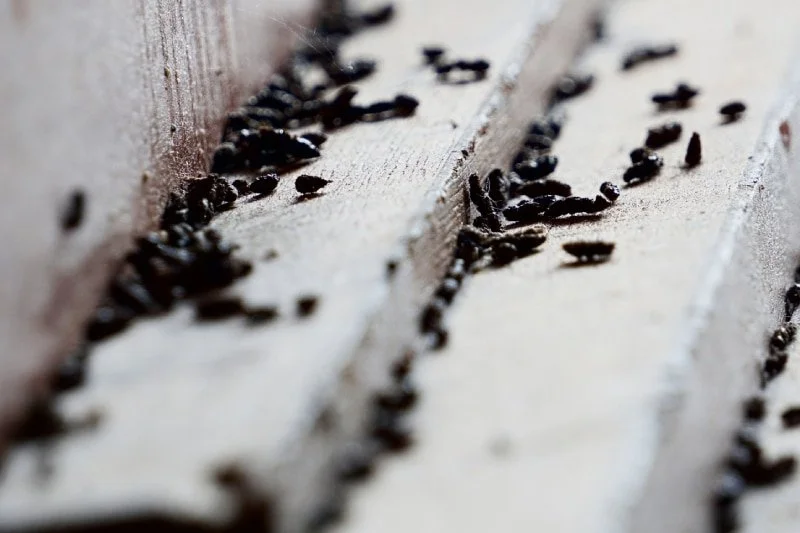
- Droppings along the base of a wall on the downhill elevation
- Daylight visible under a slider or a walk-out door when you crouch to look
- Nesting material appearing in a storage room or under stairs
- Gnaw damage on wiring or a condensate line
Service penetrations we check
- Door sweeps and slider tracks on a walk-out lower level
- The refrigerant line set and its condensate drain
- Where a generator, EV charger or exterior outlet was fed through
- Cable, satellite and low-voltage entries
- Hose bibs, gas lines and radon piping
- The junction where the foundation meets the siding
Age Is Not the Variable People Think It Is
There is a persistent assumption that mice are an old-house problem, and on entry points it does not hold. Age gives a building settlement cracks and worn sills, which is real. It does not give it a service penetration cut through the wall a few years ago.
Service penetrations are the great leveler. Every house acquires them whenever anything is added: air conditioning, a generator, a car charger, a water treatment system, an alarm. Each one is a hole made after the building was weatherproofed, by a trade whose scope is the equipment rather than the building envelope.
Which is why we walk a five-year-old house as carefully as a hundred-year-old one.

Why Avon Calls Us
- Exclusion is the part of this work we are known for, and mechanical penetrations are easy to overlook
- Our Farmington office is in the next town south of Avon, so scheduling stays tight
- We seal so the equipment keeps working, which is a different job from filling a hole
- No contract at any stage, with prevention continuing only while it is working
- Third generation in the trade since 1976, under supervisory license S-6070
What Avon Clients Say
Mouse Questions from Avon
Can I just foam around the line set myself?
Would my HVAC company have sealed it?
Our lower level is a walk-out. Is that the problem?
How many of these penetrations does a typical house have?
Is it safe around children and pets?
How much does mouse control cost in Avon?
Every Service We Offer in Avon
Walk Both Elevations, Not Just One
Two checks before you call. Look behind the condenser at where the refrigerant lines enter the wall, then walk the downhill elevation and crouch at the doors to see whether daylight shows under the sweeps. Between them, those cover most of what we find on a house built into a slope.
On a slope-built house, the two ends of the same wall are two different problems.