

Mouse Control in Farmington, CT
A Farmington mouse problem often has an address the homeowner has not thought about. The house gets the sightings. The detached garage, the barn, or the pool house across the lawn is where the population lives, and until that building is part of the job, the house keeps getting restocked.
Found droppings you cannot place? Send a photo, and we will read it with you.
The Building Nobody Mentions on the Phone
Farmington spreads roughly 28,000 people across the 28.7 square miles the town claims as its own area, which comes to nearly 1,000 per square mile. West Hartford, one town over, packs more than twice as many people into a smaller footprint. That arithmetic is why outbuildings are ordinary on the properties we visit here and unusual across the line. A detached garage set back from the house, a barn from when the parcel was working land, a pool house, a workshop, a storage building at the end of a gravel drive. Every one of those is, from a mouse's perspective, a better home than yours: quiet, unheated or barely heated so nothing dries out, and stocked with cardboard, insulation, stored upholstery, birdseed, grass seed and a bag of dog food. Nobody is watching, so a population grows for years without producing a single sighting that prompts a phone call.
Then it spills. Those populations do not stay put once resources inside get tight, and the house across the lawn is the warmest structure in range. It is why a household can have a professional treatment done, get a clean result for a season, and find droppings again the following year with no obvious failure in the work. The work was fine. The reservoir was never in scope.
The walk therefore goes out to those buildings instead of stopping at the driveway, and the question on the phone beforehand is what the property actually consists of.
How We Scope a Whole Property
You talk to a person
No phone tree, no salesman, and no sales-side handoff. Tell us what is on the property, including the buildings that seem irrelevant.
A free evaluation of the whole property
Free, and we confirm the day before and again twenty minutes before we pull in. We walk the outbuildings.
Population first, across every structure that matters
Numbers first and structures in the right order, because a building that is still producing juveniles will keep feeding the one you just cleared. Reducing the number of people in the house while the barn keeps producing is how a job ends up recurring.
Then we seal in the right order
Durable materials low on the structures where the traffic runs. Sealing before the population is down traps mice inside, so the sequence is fixed.
What We Find and Where
Signs in the house
- Scratching or movement in a wall, ceiling or attic once things are quiet
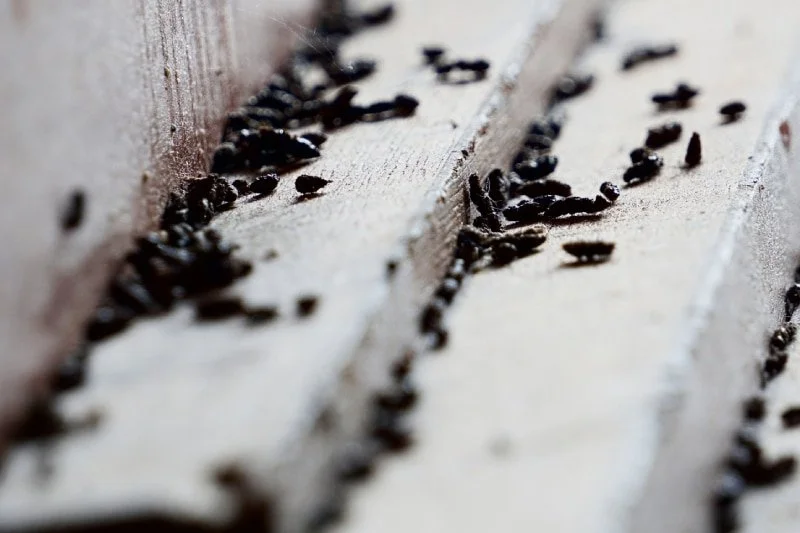
- Droppings around the size of a grain of rice
- Dark smudging along a regular travel route
- Gnaw damage on wiring, HVAC lines or alarm cable
Signs in an outbuilding people miss
- Droppings on a workbench, a windowsill or inside stored boxes
- Chewed corners on bags of seed, feed or fertilizer
- Nests inside stored cushions, upholstery, insulation or a boat cover
- Shredded cardboard at the base of a stack
- Gnawing on the wiring of stored equipment and seasonal machinery
How they cross the ground between
- Along a stone wall, a hedge line or a fence run, because mice rarely cross open lawn if there is cover
- Down the length of a gravel drive, using the edge where the stone meets the grass
- Through a run of stacked firewood, which is a staging post rather than a destination
- Under a deck or a porch skirt, which is usually the last stop before the house itself
- Along an underground conduit trench between an outbuilding and the main panel, which stays looser than the soil around it
Sealing an Outbuilding Is a Different Job
A house gets sealed at the foundation and siding junction, because that is where the traffic is. A barn or a detached garage rarely offers anything that tidy. Sills sit straight on a slab or on piers with daylight under them, board siding has opened up with age, and there is usually a service door that has not closed tight to its frame since the Reagan administration.
We are candid about how far it makes sense to go out there. Sealing a hundred-year-old barn to the standard we would hold a house to is rarely the right use of anyone's money, and we will say so. More often the useful work is reducing what the building offers, closing the two or three openings that carry most of the traffic, and then making sure the house itself is properly sealed so that what is living in the barn stays in the barn.
That split is the honest version of the recommendation, and it is usually a smaller job than people brace for.
Mouse Questions from Farmington
We had this treated last year, and they are back. What happened?
How do you tell which building they are actually living in?
Are the materials safe around children and pets?
Is it worth doing anything about the barn if we barely use it?
How much does mouse control cost in Farmington?
What Farmington Clients Say
What You Get from a Local Team
- An office at 769 Farmington Avenue, which keeps scheduling tight and follow-up quick
- Exclusion is our signature service, sealing with materials chosen to survive gnawing, which is a different standard from looking finished
- We scope the whole property, including the structure nobody thought to mention
- Third generation in the trade since 1976, operating under supervisory license S-6070
- No contract at any stage, and ongoing prevention continues only while you want it
Every Service We Offer in Farmington
Start With the Whole Property
Call and tell us what the property actually consists of. The walk takes a little longer, and it is the difference between a result that holds and one that does not.
Find where they actually live, and the house stays quiet.