
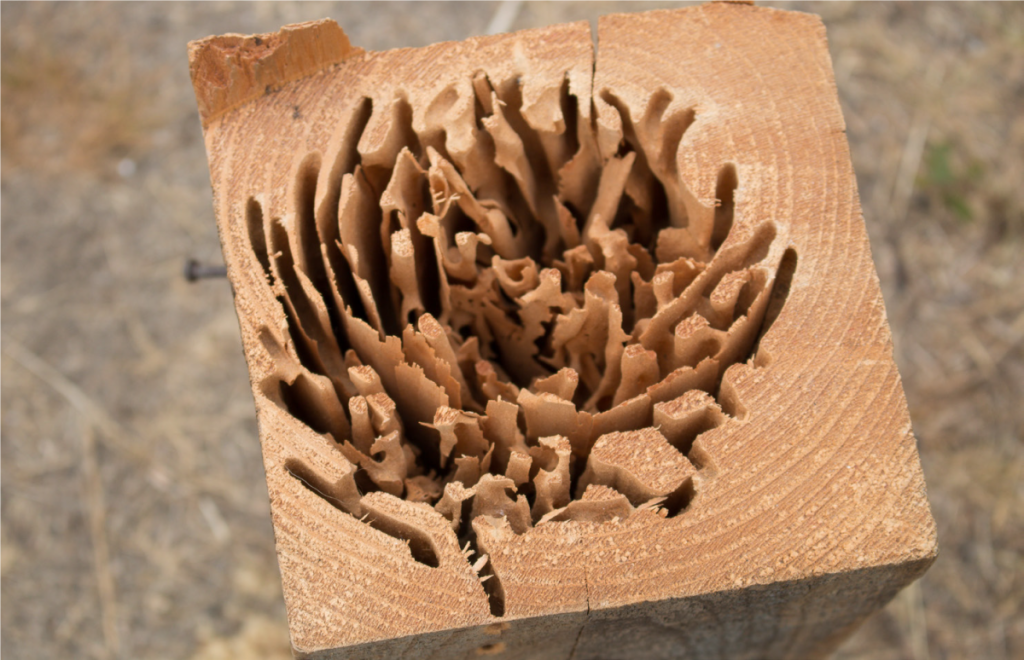
Carpenter Ant Control in Farmington, CT
Plenty of Farmington carpenter ant calls do not start at the house at all. They start at the deck. A structure bolted to the side of a home, exposed to weather on every surface, and now old enough that the details holding water out have had time to fail.
Large black ants, or winged ones indoors? Photograph them before you clear them. Distinguishing ant from termite comes first.
What Makes Them Their Own Problem
The single question that decides everything here is whether you have an ant or a termite, and the answer changes the urgency, the method, and the cost bracket all at once. Photograph the insect before you clear it. A carpenter ant is the larger of the two, with a pinched waist and bent antennae; a termite is smaller and straight-sided. If there are winged ones, the season narrows it further, because termites go in Spring and carpenter ants in Summer.
They go where wood has softened, so a carpenter ant problem is usually a water problem wearing a different hat. Early damage is often cosmetic, and there is no reason to panic over a trail on a railing. Trouble arises when the problem goes unaddressed for several seasons, or when a repellent spray breaks a colony into satellites and pushes it farther into the building.
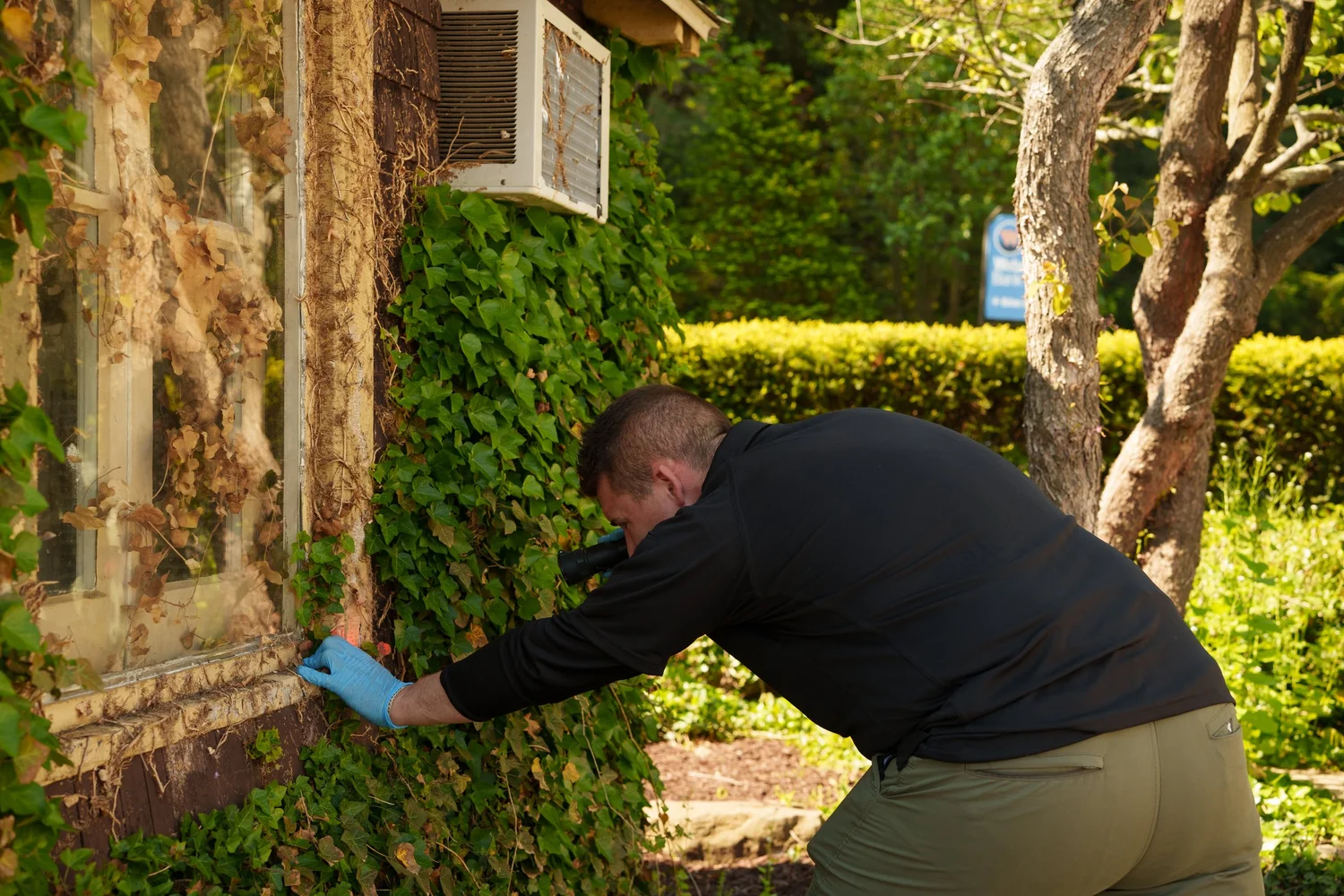
The Sequence We Follow
Send the picture first
Thirty seconds with a photograph saves two weeks of treating the wrong insect.
Free evaluation, with the exterior structures included
Free. Confirmed the day before, with a twenty-minute heads-up on the day. Decks, porches, and attached structures get walked properly.
We find the water
Where it is entering, what it has softened, and how long it has likely been doing it.
Clear scope and price in plain language
Including an honest read on how far the damage has gone. No pressure and no contract.
Whole-structure treatment, walls left closed
Rather than hunting satellite nests through your finishes, the protocol makes the structure unable to support a colony.
Prevention keeps the door shut
Foragers keep arriving from dead wood in the surrounding area, so ongoing protection is what stops the yearly repeat.
Thirty-Year-Old Decks and the Ledger Board
Where you live in Farmington tends to decide which version of this problem you have. Around the village center and through the older parts of Unionville, houses carry original porches, and the wet wood we find is generally in a column base, a porch deck, or a sill. In the later subdivision housing we visit, the equivalent structure is a deck, and many of the ones we walk are now between twenty-five and thirty-five years old.
That is roughly the age at which the connection details start to matter. The board fastening a deck to the house, the ledger, sits tight against the wall sheathing with the rim joist behind it. The flashing over that joint is the only thing keeping water from running down between the two.
Ledger flashing is a detail we often find missing outright, and where it is present, twenty-five Winters of freeze and thaw, fastener movement, and trapped debris will have tested it.
When it lets go, the water goes exactly where nobody can see it: into the rim joist, the band of framing tying the floor structure to the foundation wall. It stays damp because it is sandwiched and shaded. Carpenter ants find that band of soft, protected wood and get a nest site inside the structure, adjacent to a wall, invisible from the deck above and the basement below.
The pattern is recognizable once you know it. Ants trailing a deck rail or the siding above it. Frass on the boards near the house. Activity that peaks when it rains. Treatments that clear visible ants while leaving the nest untouched.
Screened porches, sunrooms and roofed decks produce their own versions at the roof-to-wall junction and where posts meet a slab or a pier. Anything behind the siding stays an open question until it is opened.
What to Look For
What points to carpenter ants
- Sawdust-like shavings under trim, sills, deck boards or a ledger
- Winged swarmers indoors, most often in Summer
- Large black or reddish ants working a trail along a rail or the siding above it
- Activity that noticeably picks up after rain
Places we check on these properties
- The ledger connection and the rim joist behind it
- Deck posts and stair stringers in contact with soil or a footing
- Screened porch and sunroom roof-to-wall junctions
- Wall voids behind exterior doors and windows
- Exterior wall insulation, which is easy for them to excavate
Why Homeowners Here Stay with Us
- Our office is at 769 Farmington Avenue, so getting back out is quick if anything comes up
- We trace the ants to the water source, which determines whether the problem returns next year
- Whole-structure treatment, so your siding, trim, and interior finishes stay intact
- Non-commissioned licensed technicians under supervisory license S-6070, third generation in the trade since 1976
- We flag the carpentry and flashing work honestly and tell you which trade should handle it
Recent Google Reviews
Carpenter Ant Questions from Farmington
They are all over my deck. Does that mean the deck is ruined?
Can I do anything myself while I wait?
Will you need to take my walls or my deck apart?
Why does this happen every Summer?
Can you repair the flashing or the ledger?
My house is from the nineties. Is it too new to have this?
Are the treatments safe around children and pets?
How much does carpenter ant control cost in Farmington?
Every Service We Offer in Farmington
Before Next Summer's Swarm
If the ants are on the deck, the deck is where we start. A free evaluation covers the ledger, the posts, the porch, and the house itself.
Find the water and the ants stop being an annual event.