
Termite Control in Bloomfield, CT
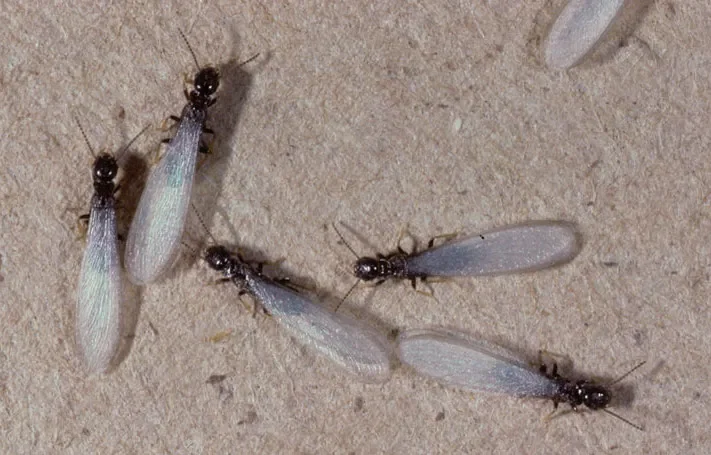
A homeowner calls because there are winged insects at a ground-floor window, and the first thing we want to know is what the house is sitting on. If the answer is a slab, that changes where we look before anyone arrives.
A Slab Is a Lid, Not a Barrier
If your house sits on a slab or over a shallow crawlspace rather than a full basement, that foundation type changes a termite job in a specific way.
Concrete stops them cold. What they use is every place the slab is interrupted. A slab has a cold joint where the floor meets the foundation wall, plus a penetration at every point plumbing comes up through it: the toilet flange, a tub drain, a shower, a washer standpipe, a radon pipe. Each of those is a gap around a pipe, often filled with aged sealant. Slabs also crack as they cure and settle, and a crack a homeowner could not see is wide enough.
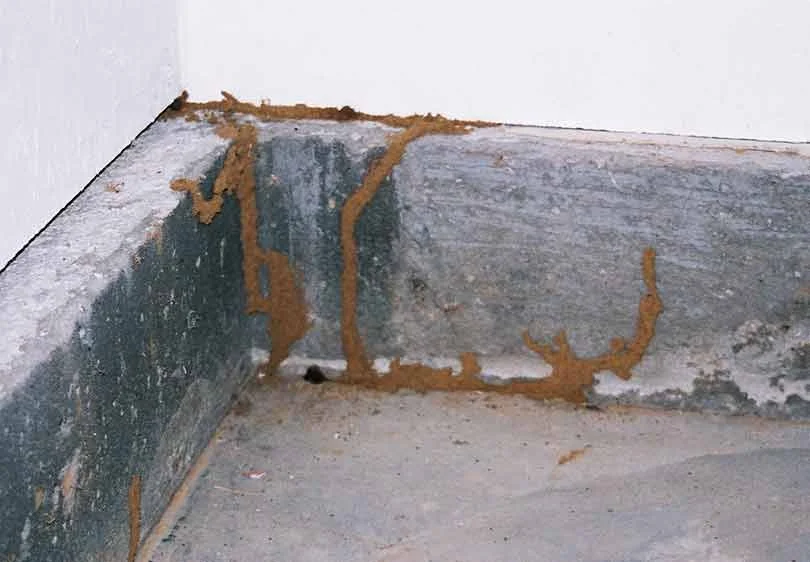
The consequence is that on a slab house, the termites arrive underneath the living space instead of at the outside of it. That is the opposite of the intuition most people have, which is that this is something happening out by the foundation plantings. It also explains why the first sign is frequently swarmers appearing inside a ground-floor room with no mud tubes visible on the exterior: there is no exposed foundation wall for a tube to climb.
None of which makes a slab house riskier than any other; plenty of the ones we treat are perfectly sound. What it does mean is that two Bloomfield addresses a mile apart can require genuinely different inspections, and the foundation is what tells us which. It means the inspection runs differently: interior penetrations, the perimeter joint, the garage slab junction, and any plumbing access, in place of an hour on the outside looking for tubes that a slab house was never going to produce.
There is a second thing about Bloomfield ground worth knowing. Close to 29 percent of the town is mapped as prime farmland soil, and roughly two-thirds of that is built on now. This was dairy and tobacco country until the automobile carried Hartford's suburbs north of it, and the houses went up on the fields. Buried farm wood does not announce itself: a fence line cut off rather than pulled, a post sawn at grade, the sill of something that used to stand there. Termites live in the soil and commute into wood, so buried wood on the lot is a colony site with nothing visible above ground to point at it.
What a Slab Changes About the Treatment
For a house with a full basement, the treatment is largely a trenching job: a band of treated soil is worked in against the foundation from the outside, and the exposed wall is right there to inspect afterward.
A slab removes both of those conveniences. There is no exposed foundation wall to read, and the soil that needs treating is partly beneath the concrete rather than alongside it. Which is why slab work involves drilling: a line of small holes through the slab edge or the adjoining hardscape, so the material reaches the soil beneath the slab.
That sounds more invasive than it is. The holes are five-eighths of an inch, sealed by hand the same day, and on most properties, most of them are outdoors, in a driveway or on a patio. Before anything is drilled, we mark the line with you and establish what is in the slab, because slabs can carry radiant tubing, conduit, and supply lines, and that has to be established first.
What the Treatment Day Looks Like
Call, and we move
Most termite work can be completed the same day as the evaluation once you authorize it.
We confirm the species
Termites versus carpenter ants change the entire approach, since termites colonize in the soil while most other wood-destroying insects live in the wood itself.
We establish the foundation type first
Slab, crawlspace, full basement, or a combination, because it determines the whole inspection.
Liquid soil treatment around the structure
A continuous treated zone at the points termites actually use to reach the building.
Minimal, clean drilling where a slab demands it
Small five-eighths-inch holes to reach the soil beneath, sealed by hand immediately afterward, and almost entirely outdoors where the construction allows.

Signs Worth a Phone Call
- Winged swarmers indoors in Spring, particularly in a ground-floor room
- Shed wings on a sill, by a door, or caught in a web
- Mud tubes on a foundation wall, a pier, or the exposed edge of a slab
- Wood sounding hollow, or narrow galleries visible when probed
- Termites turned up while gardening, or found by a contractor mid-renovation
Termite Questions from Bloomfield
We are on a slab. Does that make us more likely to get them?
There are no mud tubes anywhere outside. Does that mean we are clear?
We have radiant heat in the slab. Does that rule out treatment?
Can you tell what the foundation is before you come out?
We have a finished basement. Does that complicate things?
How much does a termite treatment cost in Bloomfield?
Reviews and Ratings
Every Service We Offer in Bloomfield
Why This One Rewards Experience
- More than 2,500 termite problems resolved personally by our owner, who is licensed for termites and has probably done more liquid treatments than anyone working in this state
- Two decades of reading how houses in this valley are built and where they fail
- Termite work done by our own licensed technicians, never subcontracted
- Families and pets can remain on site during treatment
Tell Us What the House Sits On
Slab, crawlspace or basement. That one answer shapes most of the conversation that follows.
The foundation tells us where to look before we have set foot on the property.