

Mouse Control in Granby & East Granby, CT
How does your water get into the house? If the answer involves a private well, it also involves a buried line, a penetration through the foundation, and, frequently, a pit or a small building that nobody has opened in years.
Not sure what you have found in the cellar or the pump house? Send an image.
Why Rural Mouse Pressure Never Really Stops
Rural surroundings support far more mice than a suburban lot does.
What that means practically is that exclusion carries more weight here than it would in town. On a property with modest outside pressure, a decent seal plus a bit of luck can hold for years. On a property with fields on three sides, every opening is continuously tested by a population that is replaced from outside, no matter what happens indoors.
It also means the goal is worth stating honestly. Nobody is going to empty the surrounding land of mice. What we can do is make the buildings a poor option and keep them that way, which is the achievable objective.
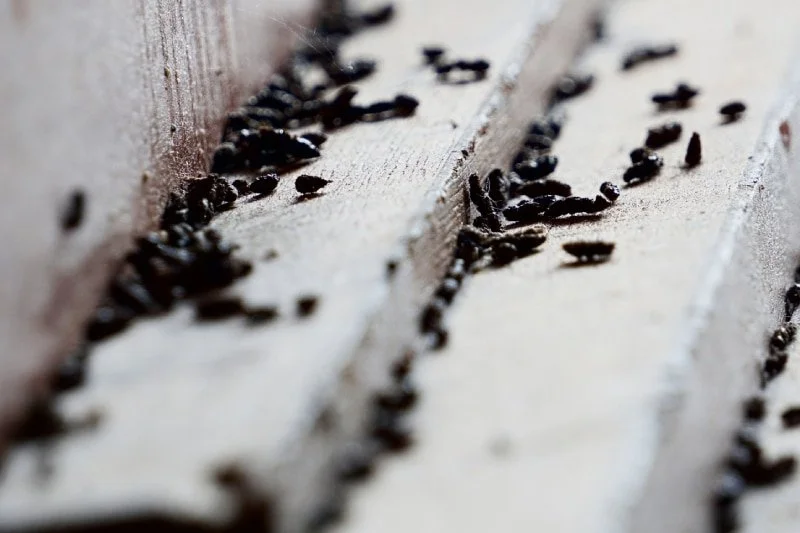
Signs, and Where We Look
What you notice
- Droppings in a cellar close to where a service line comes through the wall
- Activity that starts near the mechanical corner and spreads from there
- Nesting material in a pump house, a pit or an unheated utility space
- Chewed insulation on a pipe run or a well line
- Gnaw damage on wiring, including to equipment in an outbuilding
Service infrastructure we check on a well-and-septic property
- The well line penetration through the foundation
- Well pits and pump houses, including the lid seal and the conduit into them
- The electrical run out to a well or an outbuilding
- Septic risers, cleanouts, and any inspection port
- Propane line entries and the gap around them
A Well Line Is a Tunnel With a Pipe In It
A house on municipal water has one service entry, usually sleeved, often the only hole of its kind in the building. A house on its own well has a good deal more infrastructure than that, and most of it is buried.
The line from the wellhead is normally run below frost depth, which means a trench is dug, a pipe is laid in it, and the whole thing is backfilled. Backfill stays looser than undisturbed soil, and it runs in a line from a structure in the yard to a hole in your foundation. That makes the trench route easier going than the ground either side of it.
Then there is what sits at each end. Penetration into the foundation is usually drilled rather than formed, and the seal depends on who did it and when. A well pit, where there is one, is a small underground room with a lid, a conduit and usually a gap where the lid does not sit flat. A pump house is an unheated outbuilding with a pipe going into the ground. Each of those is somewhere a mouse can be dry, undisturbed, and close to the building.
The same applies to the other buried services that come with rural property. The electrical run to a barn, the septic riser that has settled a little, the propane line. Every one of them is a trench going somewhere and a hole where it arrives.
The age of what you are standing in matters too, and it differs sharply between the two towns. Granby's median house dates to 1978. East Granby had 1,327 residents in 1950 and has grown from there, so a good deal of that town has seventy years of settling, patching, and re-trenching behind it. Older buried work has been opened and closed more times, and every one of those is a joint somebody made by hand.
We spend real time on infrastructure people do not think of as part of the house. The well line is one we regularly find carrying traffic, and it is rarely inspected.
The Order We Work In
Somebody picks up
No phone tree, no salesman. Tell us what the property includes, including the well and any outbuildings.
A free evaluation of the whole property
No cost in our service area, with a call the day before and another twenty minutes out.
We trace the services
Well line, pump house or pit, electrical runs, septic and propane, plus the ordinary entries lower on the building.
The scope and the number, plainly
Including whether sealing makes sense now or once the population is down. No pressure, no contract.
Population first, across the structures that matter
Success here is a population that has stopped replacing itself.
Then sealing, done so the services still work
Durable rodent-appropriate materials at the penetrations, fitted so pipes and conduits keep working.
Mouse Questions from Granby
Can you seal around the well line without causing a problem?
We have a pit, not a pump house. Does that change things?
Our house is not that old. Why are we getting mice?
Should we be sealing the barn to the same standard as the house?
Is it safe with well water, and with animals around?
How much does mouse control cost in Granby?
What Granby Clients Say
Every Service We Offer in Granby & East Granby
Why These Towns Call Us
- We scope the whole property, including the buildings nobody thought to mention
- Exclusion is the part of this work we are known for, sealed with materials chosen to survive gnawing
- Comfortable with rural infrastructure, because a well line and a septic riser are ordinary to us
- No contract at any stage, with prevention continuing only while it is working
- Third generation in the trade since 1976, under supervisory license S-6070
Tell Us Where the Well Is
That, and what else is buried between it and the house, shapes most of the evaluation.