
Termite Control in Granby & East Granby, CT
The question we get most often from households on a private well is about the water, and it usually determines the decision. So let us deal with it first, properly, at the top of the page where it belongs.
The Question Behind the Question
When somebody on a private well asks whether a liquid termite treatment is safe, they are usually asking three separate things at once, and they deserve three separate answers.
Will it move through the soil into my water? Termidor High-Efficiency formulations contain polymers and adjuvants that bind the material to soil particles so it does not relocate or percolate once placed. It is designed to remain in the treated zone, which is also why a single correct application continues to protect for years.
Has anyone actually tested this? This product is registered by the US EPA and in Connecticut, and its label carries the use restrictions set by registration. We are happy to provide you with the label to read before you decide.
What will you actually do at my house? That is the part that varies, and it is best talked through on site.
Treating Around a Well, in Practice
About five percent of Granby's land area has access to public water or sewer. The rest runs on private wells and septic, which the town states plainly in its own planning documents. East Granby is fragmented differently again: sewer confined to the village center and the eastern business zones, and the town flagging the Spoonville Road area, where single-family homes sit at a concentration the existing service was never sized for. So across most of these two towns, a termite conversation is a water conversation first.
A liquid termite treatment is applied to the soil immediately against the structure, in a band, at the points termites use to reach the building. It is a perimeter job by design, and a wellhead is usually elsewhere on the property.
So, the practical conversation is about distance and layout, and we have it before anything starts. Where is the wellhead, where is the buried line between it and the house, and where does it come through the foundation? That last one matters most, because it is the only place the two things get close, and it is a spot we mark deliberately before anything is mixed.
On most properties this turns out to be straightforward: the well sits clear of the treated band, the line runs below the depth we are working at, and the only adjustment is at the penetration itself. That is something we confirm on site rather than assume in advance. On a minority, it needs more thought, usually when a well head sits close to the building or a drilled well is in an odd position relative to an addition, and on those we will walk it with you and show you exactly where material will be going and where it will not.
Treating first and discussing it afterward is the one approach we rule out. On a property with its own water supply, that conversation belongs at the start, and if the layout gives us pause, we will say so, even where you have asked us to go ahead.

What Sends Us Looking
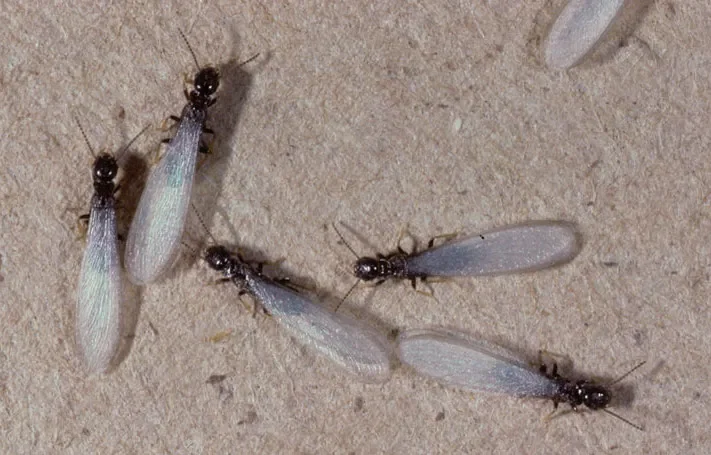
- Winged swarmers indoors in Spring, the clearest signal of the year
- Shed wings on a sill, near a door, or caught in a web
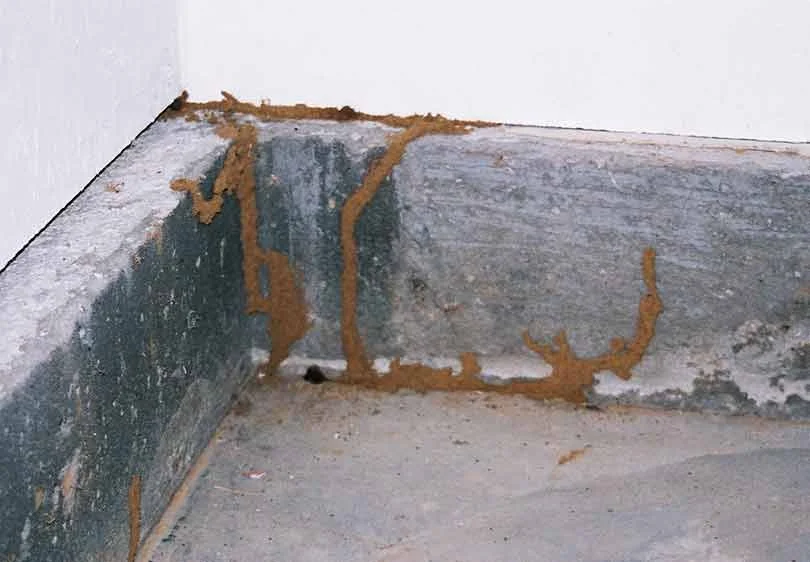
- Mud tubes on a foundation, a pier, or the side of a post
- Wood sounding hollow, or narrow galleries when probed
- Termites turned up while gardening, or found by a contractor mid-renovation
How the Work Runs
Call, and we move
Most termite work can be completed the same day as the evaluation once you authorize it.
We confirm the species
Termites colonize in the soil while most other wood-destroying insects live in the wood, which changes the whole approach.
We locate the water infrastructure
Well head, buried line, and foundation penetration, marked before anything is mixed.
We walk the perimeter and the grounds
Where wood is in contact with soil, and what the property is carrying in the way of stumps, posts, timbers, and stored lumber.
You hear the number and the plan before anything starts
Including precisely where material will and will not go.
Liquid soil treatment, with the layout respected
A continuous treated zone at the points termites actually use, worked around what needs to be worked around.
Why This One Rewards Experience
- Two decades of this work and 2,500-plus problems resolved by the owner personally, who holds the termite license
- Termite work done by our own licensed technicians, never subcontracted
- We have this conversation with well-served households constantly and are comfortable having it in detail
- Up to about ten years of protection from one correct application, with no bait stations to service
- A one-year service guarantee including any inspections or re-treatments needed in that period, renewable annually and transferable if you sell
Termite Questions from Granby
Can I see the label before I agree to anything?
What if the well head is close to the house?
Is there a non-liquid option?
Will you have to drill?
Is it safe around family, pets and livestock?
How much does a termite treatment cost in Granby?
Reviews and Ratings
Every Service We Offer in Granby & East Granby
Ask Us About the Well First
It is the right question, and answering it properly beats having you put the whole thing off for another season.
Read the label, walk the layout, then decide.