
Termite Control in West Hartford, CT
Subterranean termites are serious, and they are slow. When found early and treated correctly, there is rarely cause for alarm, and one conversation is usually enough to replace panic with a plan. On West Hartford's older properties, the condition that most often gives a colony its opening is one that took decades of ordinary yard work to create.
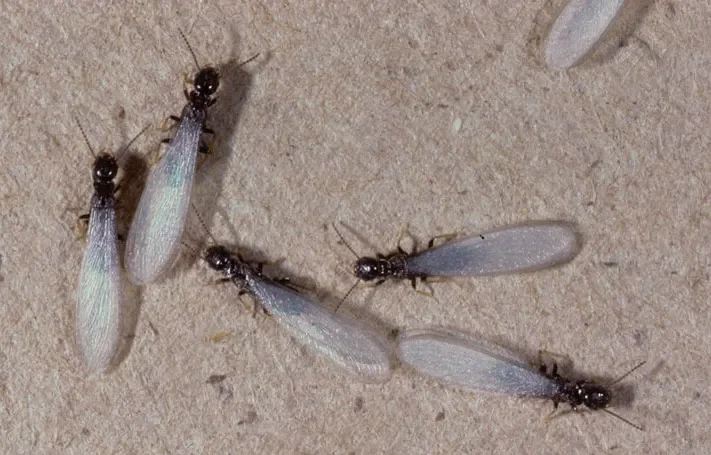
Spring is when this usually announces itself, and it announces itself on a windowsill.
The Seam Where the Porch Was Enclosed
A lot of the West Hartford housing we work on dates to the trolley era and the interwar buildout, and houses of that period were designed with open porches. On the ones we walk, most of those porches are now something else: a sun room, a breakfast room, a mudroom, a family room. Add the additions that have gone on over ninety years, and you have a building whose foundation was not poured in one go.
That matters to a termite for one reason: every one of those projects created a joint between original foundation work and newer foundation work, down at grade, usually concealed behind a step, a skirt, a planting bed or a slab poured up against it. Old rubble or brick foundation meeting a later poured wall, or a shallow frost footing, rarely makes a seal anything like the walls on either side of it.
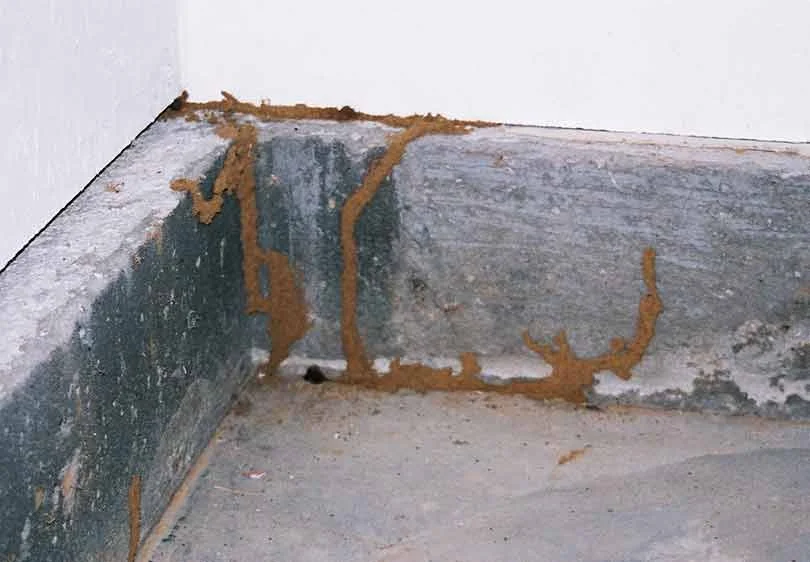
Termites need warmth, moisture, and access to wood, and a seam like that offers all three while staying out of sight. It is why we walk the perimeter of an older West Hartford house looking for where the building changes rather than where it looks weakest. The original 1925 wall is often fine. The 1968 family room, which ties into it, is where we find the tubes.
What We Find, and Where
After thousands of termite jobs, the search pattern is not a mystery. Masonry porches are the first place we look because stone, brick, and cement retain the day's heat and keep the soil beneath them active later in the season while concealing the wood-to-soil contact. The garage is second, specifically the junction where the driveway, foundation and slab meet, which offers warmth, moisture and a hidden path to wood all at once, usually with cardboard and firewood stacked on the slab nearby.
Termites eat wood from the inside out and stay hidden while they do it. Most of the skill in finding them is knowing their preferences, which is the part that rewards repetition more than almost any other pest service.

One Application, Start to Finish
Call, and we will move
Termite matters get priority handling in our scheduling, ahead of routine work.
We confirm it is termites
Termites versus carpenter ants change the entire approach, since termites colonize in the soil while most other wood-destroying insects live in the wood itself.
You get a clear scope and price
Exactly what is needed to stop them, and nothing beyond. No pressure and no contract.
We treat with Termidor High-Efficiency liquid
A liquid soil treatment around the structure creates a zone termites pass through undetected and carry back through normal contact, which works the colony down rather than only the foragers in the wood.
The treatment becomes the prevention
The liquid adheres to soil particles and stays put, providing up to about 10 years of protection from a single correct application, with no monitoring subscription required.
We stay reachable
Termite work carries a one-year service guarantee including any inspections or re-treatments needed in that period, renewable annually and transferable if you sell.
Signs Worth a Phone Call
- Winged swarmers emerging indoors in Spring
- Shed wings on a windowsill, near a door, or caught in a spider web
- Mud tubes on a foundation wall, a porch pier, or a basement wall
- Wood that sounds hollow, or shows narrow galleries when probed
- Termites turned up in soil during gardening or found by another trade mid-renovation
Before You Sweep Them Up
Swarmers indoors are the clearest signal a homeowner gets all year, and they are also the easiest evidence to destroy by accident. Keep a few in a jar, an envelope, or a strip of tape, or photograph them somewhere with decent light. Note which window or door they appeared at and roughly when. Termite and carpenter ant swarmers look similar enough at a glance that the specimen decides the plan, and the location narrows where we start looking.

Why This Is the Service to Get Right
- Our owner is licensed for termites and has personally resolved more than 2,500 termite problems over the past twenty years, likely more liquid treatments than anyone in the state
- Treated in-house with Termidor High-Efficiency and never subcontracted
- A liquid application protects the structure immediately, where a bait system only begins working once termite workers find the stations
- Families and pets can remain on site during treatment, since the application goes into the soil around the structure rather than through your living space
Reviews and Ratings
Termite Questions from West Hartford
I found winged insects indoors. Are they termites?
I see mud tubes and damage but no live termites. Do I still treat?
How bad is it if I have them?
My yard has been landscaped for decades. Does that matter?
How long does the protection last?
Is the treatment safe around my family and pets?
I have well water. Should I be concerned?
What about the drilling?
Do you write termite letters for a home sale?
How much does a termite treatment cost in West Hartford?
Every Service We Offer in West Hartford
Tell Us What You're Seeing, We'll Take It from There
Whether you have found swarmers or you simply want the house protected, you get a real person, a free evaluation, and two decades of termite work behind the recommendation.
Calm, correct, and sized to the house it is protecting.