

Mouse Control in West Hartford, CT
Most West Hartford mouse calls start the same way. Somebody hears scratching above a bedroom ceiling on the second or third floor, looks for a hole up there, and finds nothing. The hole is almost always at the bottom of the house. Getting from one to the other is a feature of how homes in this town were built.
Hearing something in the walls? Send us a photo of the droppings or the damage, and we will help you read it.
What Actually Solves a Mouse Problem
Three assumptions keep West Hartford households fighting the same mice for years.
The first is that mice arrive in the Fall. They do not. Mice live indoors year-round because it is warm, safe, and close to what they need. Cold weather changes where they forage, which changes when you notice them. After a light snow, walk the foundation and look for tiny footprints tracing the perimeter. That is proof of residents, not arrivals.
The second is that sealing the house is the right first move. Seal a house with mice still living in it and you have closed their route back out to water and food. They range farther into the living space, and the ones that die do so inside the structure. Population first, sealing second. Reverse it, and you make the problem worse.
The third is that a few traps will keep up. A female can gestate roughly every two months with eight to twelve pups at a time. A handful of traps rarely outpaces that, especially when the nest sits in a wall void nobody has opened.
Signs and Entry Points in a West Hartford Home
What you will notice first
- Scratching or scurrying in a wall, ceiling or attic once the house goes quiet
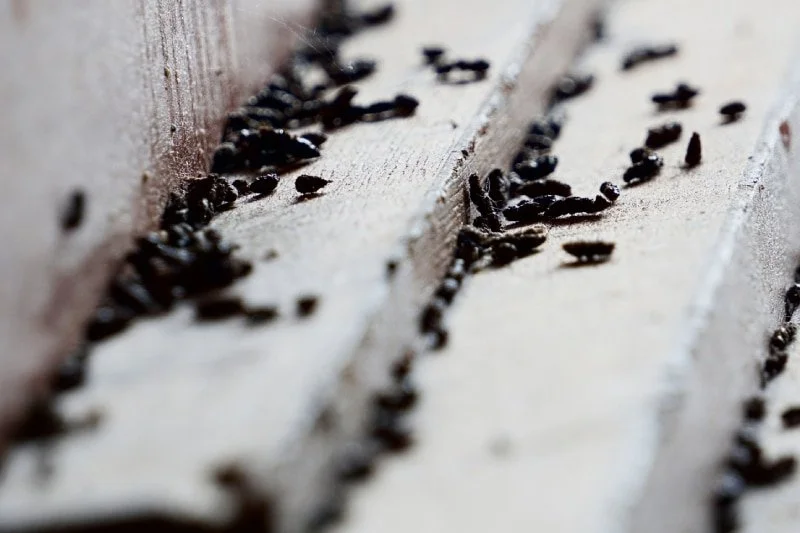
- Dark droppings roughly the size of a grain of rice
- Shredded paper, insulation or fabric gathered into nesting material
- Greasy smudge marks along a travel route, often at the base of a wall
- Gnaw damage on wiring, an HVAC line or alarm cable
Where they get in
- The junction where the foundation meets the siding, which is the most common entry we find
- Utility and conduit penetrations
- Pipe holes cut through floors for baseboard heating
- A garage door that no longer seals flush to the concrete
- Any gap around an eighth of an inch, which is all a juvenile needs
Where they nest once inside
- Wall voids and insulation, interior and exterior
- Above drop ceilings and behind built-ins
- Inside and behind appliances
- Attics, basements and other quiet spaces nobody visits

Why You Hear Them Upstairs When They Get in Downstairs
West Hartford filled in early. The trolley reached the town around the turn of the last century, and the population rose from roughly 1,500 in 1870 to nearly 9,000 by 1920. A lot of the housing we work on in this town went up during that stretch and the two decades after it.
Houses of that era were commonly balloon framed. In balloon framing, the wall studs run in a continuous length from the sill plate at the foundation all the way up to the roof, and the floor structure hangs off their sides. The practical consequence is that the cavity inside an exterior wall is often an open vertical shaft from the basement to the attic with nothing crossing it.
For a mouse, that is a staircase. It enters at grade where the foundation meets the siding, which is the entry we find most often, and it can reach a third-floor ceiling without ever showing itself in a room. It explains the thing homeowners here find so maddening: activity heard high in the house, no droppings anywhere near it, and no visible opening upstairs to seal.
We are not going to tell you your house is framed this way, because we have not looked at it yet. What we will do is check. On an older West Hartford home, the evaluation includes reading how the framing is likely to move a mouse around, because that determines where the work has to happen rather than where the noise is.
Later construction behaves differently, with fire blocking that interrupts those vertical runs and other weak points in its place. Same town, two different jobs.

Why This Work Is Our Signature
- Exclusion is the part most companies skip and the part we are known for, sealing the structure with materials a rodent cannot simply chew back through
- A third-generation licensed family business, operating under supervisory license S-6070, with the same technicians returning to your home rather than a rotating crew
- Zero secondary poisoning and non-lethal options are available for clients on a Preventative Maintenance Service, and there is no contract attached to any of it
The Order We Do It In
You reach a real person or send a photo
No phone tree. If you are unsure what you are hearing, a photo of the droppings or the damage usually settles it.
We schedule a free evaluation
Free to everyone in our service area, worked from the exterior. Day-before confirmation and a twenty-minute arrival update.
We read the structure and the conditions
How they are getting in and what is drawing them: the foundation and siding junction, penetrations, the garage threshold, landscaping and moisture.
You get a clear recommendation, scope, and price
Plain language and up front, including whether sealing makes sense now or after the population is down. No pressure and no contract.
We reduce the interior population first
Across all levels and spaces, with reproduction control as the goal rather than a body count.
We seal the entry points
Durable, rodent-appropriate materials concentrated low on the structure where the traffic actually is.
We keep them out
Outside pressure here is constant. Many clients pair ongoing prevention with re-sealing every three to five years, and it stays their choice throughout.
What West Hartford Clients Say
Mouse Questions We Hear in West Hartford
Does having a cat make any difference?
I hear them on the third floor. How did they get up there?
There is a smell, but I cannot find anything. What now?
Will you find every hole?
How long until they are gone?
Are the materials safe around children and pets?
My house is a hundred years old. Is that a problem?
Do mice really damage anything?
Do I need a contract?
Every Service We Offer in West Hartford
Let's Get the Walls Quiet
Tell us what you are hearing and roughly where in the house you are hearing it. That conversation, plus a free look at the outside of the building, is usually enough to explain the noise and say what the work involves.
Quiet walls again, and an honest account of how we got there.