

Mouse Control in Windsor, CT
A homeowner calls and says there are mice in the kitchen. We seal the kitchen end of the house, the activity moves to the far bedroom, and everyone concludes the mice outsmarted us. They did not. They took a route that has been in the building since someone added an addition to it a century ago.
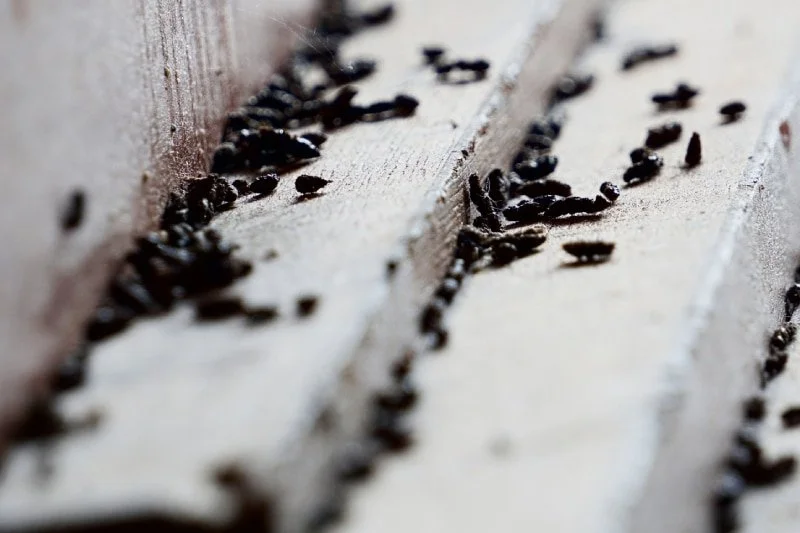
Droppings you cannot place? Send an image, and we will read it with you.
The Two Things That Decide a Mouse Result
The first is whether reproduction gets interrupted. A female can gestate roughly every two months with eight to twelve pups at a time, so a handful of traps rarely outpaces a population living in a wall void. Reducing numbers is not the same as stopping the supply of new ones, and only the second thing ends the problem.
The second is sequence. Sealing a building while mice are still living in it cuts off their route back to water and food. They instead range farther into the living space, and any that die do so inside the structure. Population first, sealing second, and reversing that order is the most common way a well-intentioned job goes wrong.
Retail products struggle with both. Retail baits compete with the food already on site, and many consumer sealing materials are not rodent-resistant, making proper exclusion harder later.
A House Made of Several Houses
More than 17 percent of Windsor's housing was built in 1939 or earlier, and the median Windsor house dates to 1970. Older housing is often added to more than once.
Structurally, that produces a building made of several buildings. An original core, a nineteenth-century ell, a kitchen wing, a mid-century family room, each with its own foundation, its own floor system, and its own framing dimensions. The pieces were joined as well as anyone could, and the floors often do not line up exactly, so the joist bays on one side of a junction may not align with those on the other.
For a mouse that is a gift. The space between two floor systems that meet at slightly different heights is a continuous horizontal run, protected on all sides, that connects one wing of the house to another without passing through a single room. It is why activity reported in one part of a Windsor house can be fed from an entry point at the opposite end of the building, and why sealing where the droppings are can produce a confident-looking result that does not hold.
It compounds with what sits underneath. Older sections frequently have rubble or fieldstone foundations while newer sections have poured concrete, and the vertical joint where the two meet is difficult to close well. That joint is generally on the outside of the building where nobody looks, behind a lilac or a stack of shutters.
On a fair number of Windsor properties, the house is also not the only structure. The first shade tent in New England went up in Poquonock in 1900, Windsor became the largest tobacco producer in the state, and the Connecticut Trust's barn survey recorded around 48 barns and tobacco sheds in town. A tobacco shed is a long, low, unheated timber building sitting on concrete piers, sided with boards hinged to swing open for ventilation. Unoccupied, undisturbed, and open underneath, it is close to the best mouse reservoir anyone ever built, and it is often fifty yards from a back door.
Read the additions and the interior pattern usually explains itself. Read the outbuildings too, because on a property like this the house is rarely the whole picture.

The Order We Work In
Somebody picks up
No phone tree, no salesman, no handoff to a sales side. Tell us what you are hearing and where.
A free evaluation, worked from outside
Free to everyone in our service area, with a call the day before and another twenty minutes out.
We read the building's history
Where it was added to, how the sections meet, and which junctions are likely to be carrying mice between them.
You get the scope and the number in plain language
Including whether sealing makes sense now or after the population is down. No pressure and no contract.
We reduce the population through the building
Wings and levels included. We are working to stop the population breeding, which is a different target from the number of mice anybody counts.
We seal, low and thorough
Durable rodent-appropriate materials concentrated at the base of the structure and at the junctions between old and new work.
We keep the outside pressure off
Many clients pair ongoing prevention with resealing every 3 to 5 years. It stays their choice throughout.
What You Will Find, and Where
Signs
- Scratching or movement in a wall or ceiling once the house goes quiet
- Droppings around the size of a grain of rice
- Nesting material pulled from paper, insulation or fabric
- Dark smudging along a regular route
- Gnaw damage on wiring, HVAC lines or alarm cable
Entries we find most on this housing stock
- The junction where the foundation meets the siding
- The vertical joint where an older foundation meets a newer one
- Bulkheads and crawlspace vents on the original section
- Pipe holes cut through floors for baseboard heating
- Any gap around an eighth of an inch
Why Windsor Calls Us
- Exclusion is the part of this work we are known for, sealed with materials chosen to survive gnawing
- We read older houses as the assemblies they actually are rather than treating them as one box
- No contract at any stage, and prevention continues only while it is working for you
What Windsor Clients Say
Mouse Questions from Windsor
We sealed where we saw them and they moved. What happened?
Our house is genuinely old. Will you be careful with it?
Can you seal it all?
Is it safe around children and pets?
Why do I only notice them once it gets cold?
How much does mouse control cost in Windsor?
Every Service We Offer in Windsor
Tell Us Where You Are Hearing Them
That, plus a free look at the outside of the building, is usually enough to explain what is going on and say what the work involves.