
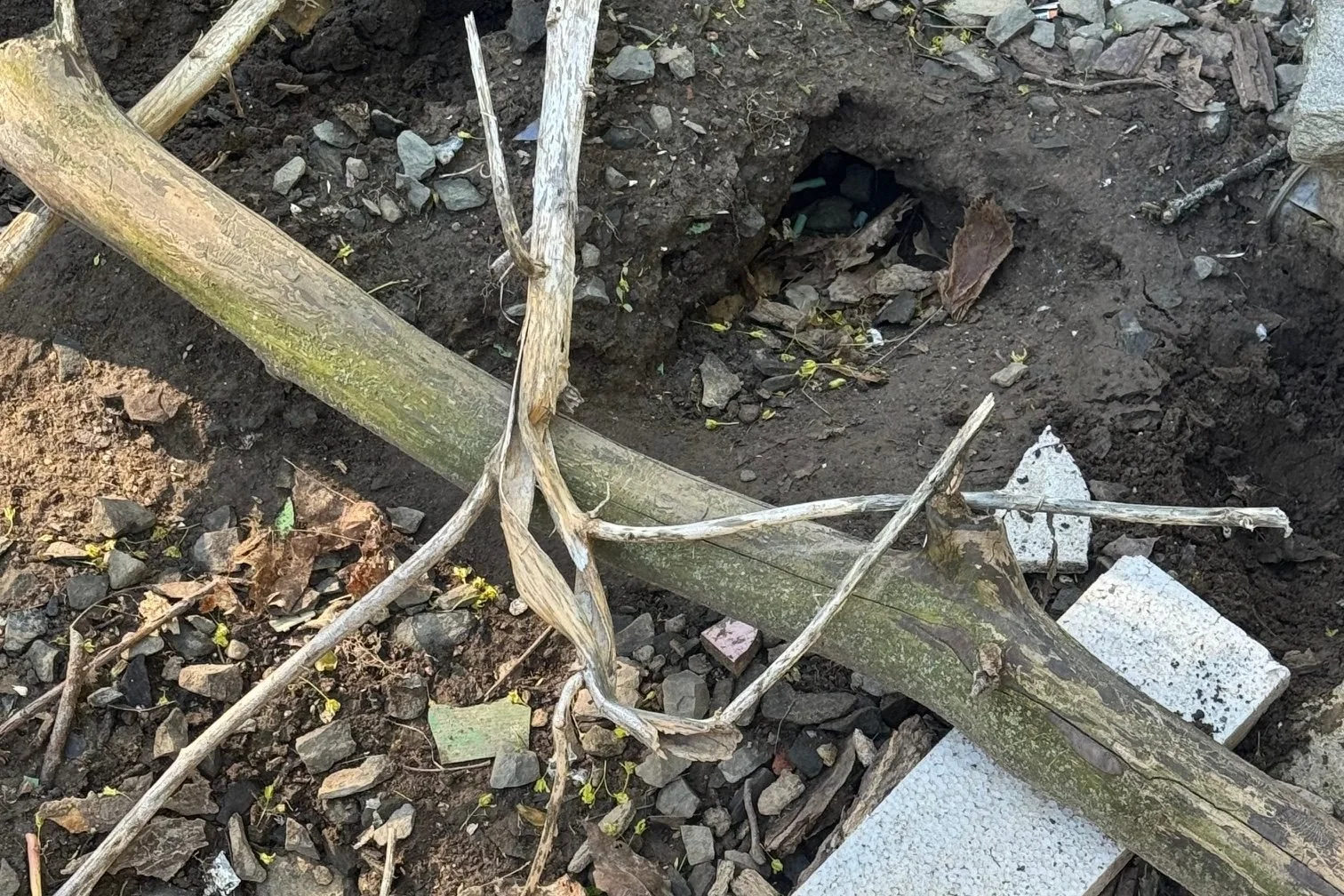
You crouch by the sill, find a gap along the foundation, and try the test everyone tries: can a finger fit? It can't, so you stand back up and cross that spot off your list. A mouse never had to pass that test. Its body doesn't work the way a finger does, and the gap you just cleared is still open for business.
That mismatch is where this misjudgment starts. People size up an opening the way they'd size up a doorway for themselves, checking whether something bulky can pass. A mouse isn't bulky in any way that matters here, and the part of it that actually decides whether a gap works is not the part you were checking.
The Skull Is the Only Measurement That Matters
A mouse's narrow, flexible body and soft fur let it flatten as it pushes forward, so it can pass an opening that looks too small for it. Pest-management references commonly give the skull as the limit: solid bone, fixed width, with no flattening available. Wherever a mouse's skull fits, the rest of it follows right behind.
That single fact is why a visual check misleads you. You're reading the gap by eye, picturing a small animal squeezing its whole outline through, when the actual question is much narrower: does this opening clear one rigid measurement, and nothing else about the mouse's size matters once it does.
Where These Gaps Open on the Outside of a House
The exterior of a house produces this exact width at several points a walk-around glance skips over: the seam where siding meets the foundation, the collar around a hose bib or dryer vent, a gap under a garage door that never fully seals to the slab, and the mortar joints of the foundation itself. A gap where a utility line or cable enters higher up the wall does not turn up in that walk-around glance; finding it takes a full circuit of the exterior.
In a poured foundation and a fieldstone one, the gap that matters sits in different places. A continuous poured wall cures as one piece, so a crack in it stays hairline-thin unless something forces it wider, which is why that kind of foundation produces fewer joints anywhere near a skull's width to begin with. A fieldstone or rubble foundation is stacked stone set in mortar, and mortar is the part that shrinks and crumbles: a joint that started too tight for a skull to pass can open to about 1/8 inch as the mortar around it ages. Settled framing above the foundation adds a second source at the same width. Where a sill plate no longer sits flush on top of the foundation, or where a rim joist has pulled slightly away from the sheathing behind the siding, the resulting gap tests at the same skull measurement as a mortar joint, just higher up the wall. Checking the mortar joints first, then the sill line where it meets the foundation, covers both sources without leaving either one unchecked.
Where the Same Size Gap Continues Once It's Inside
Getting through the exterior wall doesn't end the search; it just moves it indoors. A hole drilled a little large around a baseboard-heat pipe gives a mouse a vertical route between floors that never crosses a wall at all. The gap around a dryer vent duct, the chase behind a kitchen cabinet, or the opening under a utility sink cuts the same corner in reverse: no outside wall to breach, just another skull-width passage between one room and the next.
None of these interior gaps needs to be any larger than the exterior ones already covered. A mouse that finds a way past the foundation and up into a wall cavity is now hunting for the identical measurement one floor at a time, and a house with plenty of finished walls between rooms still offers that path anywhere a pipe, duct, or wire was run through a hole cut slightly bigger than it needed to be.
At night, turn off interior lights and hold a flashlight against a suspect seam from outside while someone checks from inside; light passing through marks a gap worth measuring and sealing, not just guessing about.
Why the Population Has to Come Out Before a Gap Gets Sealed
Closing every gap this size still leaves one problem untouched: a mouse that is already living inside the wall when the last opening shuts. It's still in there, still needs a way in and out, and a newly sealed gap in its path is now an obstacle between it and whatever brought it inside in the first place.
That's the reasoning behind treating the population and the gaps as two separate jobs, done in a set order: clear out what's already inside first, then close the routes that let it happen again. Seal ahead of that first step, and you haven't removed anything; you've just given an animal already indoors a reason to test a fresh seal from the wrong side, working at exactly the width it already knows it can pass. A mouse trapped behind a newly sealed wall doesn't relocate outdoors on its own; it dies in the cavity it was using, and the odor and the secondary pests that follow don't clear up until the source is found and removed. That outcome is why the two jobs stay in order rather than being combined into one visit.
Closing a Gap This Size for Good
A gap that measures a mouse's skull width needs a material a mouse can't wear down from either side, not just one that fills the visible hole. A mouse's incisors grow for its entire life and stay sharp through constant gnawing, which is why the material has to resist that gnawing rather than block the opening on the day it goes in. Rodent-appropriate material means something rigid or metal-based, fitted to the specific opening: a pipe collar, a foundation joint, and a vent gap each call for a different fix, but all of them share the requirement that gnawing doesn't open a new path through the patch itself.
Spray foam and caulk are built to seal air and moisture, and they do that job well, but neither one resists a mouse that treats the material as something to remove rather than a wall. A mouse gnaws through foam and caulk the same way it gnaws through wood and plastic, which is why exclusion work fits a skull-width gap with a rigid, rodent-resistant material instead, sized and shaped to the opening rather than squeezed in and left to cure. Packed tightly against the edges of the opening, that material also gives a mouse no loose edge to get a first bite into, which matters as much as the material's resistance to the bite once started. Sealing is the second phase of the work, after the population inside is cleared, and no seal is foolproof, because a house keeps settling after the work is done.
Frequently Asked Questions
Is the skull-width rule different for a full-grown mouse than for a young one?
Yes. Pest-management guidance commonly lists a full-grown house mouse's minimum opening at about 1/4 inch, roughly the width of a pencil, which is wider than the 1/8-inch gap a juvenile needs. A gap sealed against an adult mouse still needs checking against the smaller juvenile figure.
How does a mouse know a gap is narrow enough to try before it commits?
A mouse reads an opening with its whiskers before it moves its body into it. Those whiskers, called vibrissae, sense the width and texture of an edge in the dark, so the animal is testing the gap by touch rather than guessing blind, as a person would have to.
What material should actually go into a sealed gap, if not foam?
Galvanized hardware cloth with openings small enough that a 1/8-inch juvenile can't pass through, or a fitted copper mesh packed tightly into an irregular stone joint, holds up to gnawing in a way foam and caulk don't. Either one gets set into the gap and finished so it doesn't shift or pull loose over time.
Does the gap under an exterior door need the same width as a wall gap?
A gap under a door works the same way as any other opening a mouse's skull can clear, but a worn door sweep or a warped threshold can open past the 1/8-inch mark without anyone noticing, since a sweep or threshold wears with every use of the door.
Does a mouse need a gap at floor level to use it?
No. A mouse climbs rough siding, stacked stone, and vine or shrub growth against a wall to reach a gap well above grade, so a skull-width opening near a soffit or a second-story utility line is still a way in.
Can a mouse widen a gap that's already slightly too small?
Sometimes, if the edge is soft enough to work on. A mouse gnaws at the edges of wood, foam, or weatherstripping the same way it gnaws at anything else in its path, and a gap that starts at a little under 1/8 inch can widen over time if the material around it gives way.
Ask for a free exterior evaluation — a technician checks foundation joints, sill lines, and utility penetrations against the skull-width mark, then plans removal of any mice inside before new seals go in. Green Pest Control serves the Farmington Valley. Call (860) 658-2266.