
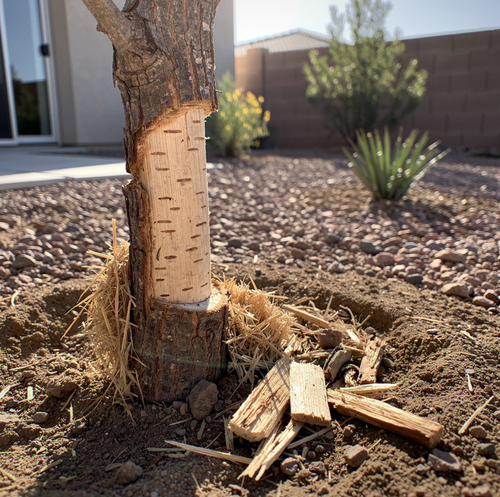
Girdling is a ring of bark gnawed away around the base of a stem or trunk, and it does more damage than its size suggests. Just under the bark runs a thin layer of living tissue that carries the sugars a plant's leaves make in sunlight down to its roots. Cut a complete ring through that layer and the roots are cut off from that supply, even while the top of the plant keeps drawing on water and looks fine, so a shrub or young tree can leaf out and look healthy for a time before it declines. Voles are why that ring shows up right at the base: they turn to bark when the green food they'd rather eat thins out, and they feed wherever they can stay out of sight while they do it, tucked under a dense planting, mulch pressed against a trunk, or tall grass left standing at a bed's edge.
What turns up at the base of a damaged plant falls into a handful of patterns, each tied to a stage of feeding and an outcome for the plant:
| What You Find | What It Shows | What It Means for the Plant |
|---|---|---|
| A gnawed band circling the base of a shrub or young tree, with fine, irregular tooth marks | Feeding at the base, underway or recently finished | A partial band, with a strip of bark left intact, gives the plant a chance to hold on |
| Bark stripped away right at the mulch line, invisible until the mulch is pulled back | Feeding happening out of sight | The full extent of the damage can be well underway before anyone notices it |
| Damage that seems to appear all at once once cover is cleared away | Feeding that went on hidden the whole time the cover was in place | The ring may already be complete by the time it's found |
| Shallow, worn paths through the grass leading straight to the base of plantings | Travel routes voles use to reach the plant repeatedly | Marks the route that control work needs to reach |
| Missing bulbs or chewed roots below the soil line, with no mark on the bark above ground | Feeding on roots rather than bark | A plant can weaken or die with no ring visible above ground at all |
| Raised ridges or small mounds of pushed soil, with the plant itself untouched | A different animal is responsible | Mole tunneling, not vole feeding |
What the Living Layer Under the Bark Carries
Just under a stem's outer bark sits a thin band of living tissue, soft enough to mark with a fingernail on a young plant. That layer is the plant's supply line: sugars the leaves make in sunlight move down through it to feed the roots, and the roots send water and nutrients back up through wood deeper inside the stem. A vole gnawing at the base cuts through the outer bark first and, if it keeps working, reaches that supply line and removes a strip of it along with the bark covering it.
Whether the plant holds on depends on how much of the ring stays intact. A partial band, gnawed on one side of the stem but not the other, leaves a strip of the living layer still connected top to bottom, and a plant can keep enough sugar and water moving through that strip to survive and, over time, grow new tissue across the wound. A complete ring, cut all the way around with no strip left connecting top to bottom, severs that supply everywhere at once. The roots stop receiving what the leaves produce, even though the water-conducting wood deeper in the stem can keep moving water upward for a while longer. That's why a fully girdled plant can leaf out and look ordinary for part of a growing season before it declines: the top is still drawing on water and on reserves stored underground, and both eventually run out.
Why Voles Feed at the Base, and Under Cover
Voles are plant-eaters, and bark isn't their first choice. Through a growing season, they feed on tender stems, seed heads, grasses, and other green material at ground level. Once that green food thins out or dies back, the sugar-rich layer under a shrub or young tree's bark becomes one of the few food sources still standing, and a vole population already living in a yard turns to it.
Feeding at the base rather than higher up a stem comes down to where a vole can work without being caught in the open. Voles are prey for hawks, owls, foxes, and neighborhood cats, and they avoid open ground where predators overhead could spot them. They travel and feed instead under whatever keeps them hidden: a groundcover planting left dense against the soil, mulch piled against a trunk instead of pulled back from it, tall grass left standing along a bed's border, and, where it lies on the ground, snow. Once any of that cover is in place, a vole can feed at the base of a plant for as long as the cover lasts without being seen.
Reading the Damage Once It's Uncovered
Not every gnawed mark at the base of a plant is a vole. Vole feeding leaves an uneven, gnawed texture, with small, angled tooth marks running in irregular patches rather than a single clean cut, and it sits low, within reach of a vole working under cover close to the ground. Rabbits gnaw bark too, but they feed standing above any mulch line, so rabbit damage sits higher on the stem and leaves a cleaner, angled cut where the incisors caught the bark in one pass. Deer don't gnaw bark the same way at all: they tear and strip it with a twisting motion, leaving ragged, torn edges instead of the cleaner removal a rodent's front teeth leave behind, and deer damage sits well above where a vole or rabbit could reach without something to stand on. Matching the marks to their height and texture goes a long way toward identifying which animal is responsible before any control decision gets made.
A light fingernail scratch across the strip of bark left beside a gnawed band shows green, moist tissue where the living layer still connects top to bottom, and dry brown tissue where it does not.
Voles or Moles?
Ridges pushed up through the lawn or small mounds of loose soil, with the plant itself left untouched, are the work of a mole tunneling after grubs and earthworms underground rather than a vole feeding on the plant above it, since the two animals eat entirely different things and leave entirely different signs behind.
Habitat Changes That Take Away the Cover
Because voles need cover to feed safely at the base of a plant, removing that cover changes where they're willing to work. Pulling mulch back from a trunk or stem, rather than piling it against the bark, removes the pocket where a vole could gnaw while staying hidden, without giving up mulch elsewhere in the bed. Dense groundcover and tall, unmown grass along a bed's edge do the same job as mulch from a vole's perspective, so thinning that growth back from the base of vulnerable plants closes off another stretch of cover a vole would otherwise use to travel and feed. Young trees and shrubs, the ones with the thinnest bark and the greatest amount to lose from a single ring, benefit from a mesh guard around the base of the trunk, set a little into the soil and slightly away from the bark, so a vole cannot reach the bark above ground or tunnel under the guard's edge. None of these changes removes a vole population on its own, but each one takes away a place voles could otherwise feed undetected, which is why habitat changes and direct control work together rather than standing in for each other.
A young tree that's already lost a complete ring around its base can die standing and fail, and one near a walkway or a play area is worth a look from a tree professional for that reason alone, separate from whatever control work addresses the voles responsible.
Treating the Runways Voles Travel
Habitat changes alone don't remove a vole population already established on a property, and a population with an existing network of runways keeps using it even after the cover directly around one plant is cleared. Voles travel the same surface paths and shallow tunnels repeatedly, so those runways are where targeted treatment goes: placed directly along the paths and burrow openings a population is using, rather than scattered across a yard where voles aren't traveling at all. Working the runways addresses the population responsible for the damage, since a single travel network can reach several plants across a yard. If a vole turns up dead near a treated area, it's handled with gloves, or not at all, since a decomposing rodent can carry parasites and pathogens best kept away from bare hands.
Rodenticide bait and snap traps can poison or injure a pet, a child, or wildlife that finds them. A licensed technician places any bait or trap in the runways, out of reach.
Frequently Asked Questions
Can girdling damage add up over more than one year without ever being a single full ring?
It can. A vole gnawing a partial band one year and returning to gnaw a different partial band the next can leave the same total loss of bark around the trunk as a single vole cutting a complete ring in one sitting, even though no year's damage looked complete on its own.
Where on a plant does vole gnawing concentrate?
At the root collar, from just below the soil line up to the top of whatever cover sits against the stem, since that is the stretch a vole can reach while it stays hidden.
What's the technical name for the layer a full ring cuts through, and why does that layer matter beyond carrying sugar?
The sugar-carrying tissue is the phloem, and just inside it lies the cambium, a thin band of dividing cells that produces new bark and new wood each year. A full ring removes all the way around, so the trunk has no living tissue left in that ring to grow new bark across the wound the way it could over a partial one.
Can damage on several plants in the same yard trace back to one feeding event?
Not one feeding event, but it can trace back to one travel network. A runway an established vole population uses gives more than one individual repeated access to the same bed, so several plants along that route can show fresh gnawing close together in time, tied to the route rather than to a single animal or a single visit.
Can a girdled plant hide its own damage later in the season?
Yes. New growth at the base, whether it's the plant's own foliage filling in or nearby groundcover coming back, can cover a gnawed ring just as effectively as whatever hid it while the feeding was happening, so a ring that went unnoticed earlier can stay hidden well after the cover that originally concealed it is gone.
Does it matter if the plant is grafted?
It can. On a grafted young tree, a full ring gnawed at or below the graft union can kill the grafted variety even when the rootstock underneath survives and sends up its own growth. New growth returning from a girdled graft isn't necessarily the tree that was planted.
Enlist vole control for the runways and cover around your plantings — travel routes and feeding sites identified, cover reduced near vulnerable trees and shrubs, and treatment placed directly in the runways. Green Pest Control serves the Farmington Valley. Call (860) 658-2266.