
Exterior Ant Treatment: Why It Stops the Ants You See Indoors
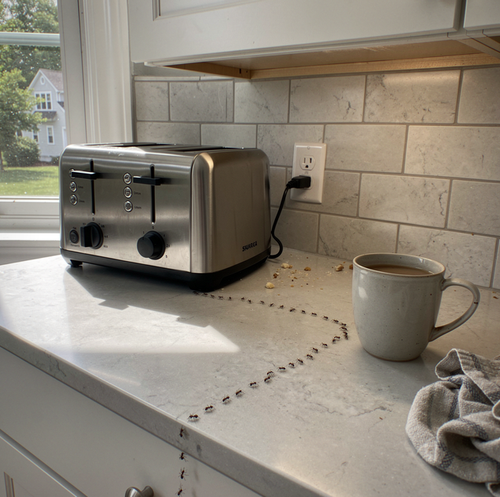
The kettle clicks off, you reach for a mug, and something tickles the back of your wrist. A thin line of ants runs from the corner of the backsplash, across the counter and behind the toaster, moving so steadily that the line barely wavers at all. Your first instinct is to wipe the whole line away and grab the spray can under your sink.
Hold off a minute. The ants on your counter are the smallest, most visible part of a colony that almost always lives somewhere you cannot see, usually outside your walls. Where you treat determines whether you get a clean counter for an afternoon or a quiet kitchen for good, and that choice gets easier once you know where your line starts.
Where the Colony Actually Lives
Here is a fact worth taking literally: most ants live outdoors, so keeping them from entering buildings matters more than anything you do once they are inside. Those outdoor nests tend to sit in soil, and nest sites vary by species but are often found next to buildings, along sidewalks, or near food sources such as trees or plants that harbor honeydew-producing insects.
Read those two sentences together and the kitchen scene changes. The nest is most likely in the soil against your foundation, under a walkway, or beside a shrub a few feet from the back door. The ants on the counter are daily commuters. They leave the nest, pass through a gap in the building, cross a wall cavity or a floor edge, and come out wherever the food is. Every ant you see indoors has a home to go back to, and that home is the part a treatment has to reach.
What Trails In From Outside the Walls?
A trail starts small. The scattered ants that show up first are stragglers, scouts randomly searching for food or nesting sites. When a scout finds something worth carrying home, the colony follows the route it marked, and the wandering few become the tidy line you found by the kettle.
That line has a starting point, and it is worth finding before anyone wipes it away. Follow it backward from the food, and it almost always ends at an edge: the gap under a baseboard, the corner of a window frame, a threshold, a crack where the floor meets an exterior wall, or the seam where a garage or basement slab meets the foundation. Past that edge, the route keeps going through the structure and out to the soil. Inside the structure, ants prefer to travel along pipes and wires to reach your kitchen.
This is why wiping the ants up feels productive and changes so little. You remove the ants that were already inside, and the colony, still healthy, sends more along the same route the next morning.
Four Questions That Point to the Right Treatment
A technician sizing up an ant problem is working through a short set of questions, and you can answer most of them before the visit by watching for a day. Each answer pushes the plan toward the outside of the house or flags the rarer case that needs a closer look.
Where does the line disappear? An exit at a baseboard, a window corner, or a door threshold on an outside wall points straight to an exterior route. A line that disappears into the floor near a garage or basement slab suggests ants living beneath the concrete. Both lead outside the living space.
Is it a trail or a few wanderers? Scattered single ants are scouts. A steady, two-way line means the colony has found something and committed to the route.
Does the line come back after you clean it? A trail that returns in the same place means the colony still has both a way in and a reason to use it. That repetition is the strongest argument for treating the route rather than the room.
Is something inside feeding the trail? A drip under the sink, a pet bowl, or crumbs behind an appliance explain why the line ends where it does. Those get corrected alongside the treatment, because a well-placed exterior barrier works best when the indoor reward is gone.
For most homes, the answers line up the same way: the colony is outside, the route crosses the wall, and the reward is inside. That pattern is exactly what an exterior treatment is built for. The less common answer, ants that seem to live inside a wall with no obvious route out, still does not call for spraying the room. It calls for a material the ants carry home, which the next two sections cover.
Before you wipe the trail, photograph it and note where the line enters the room: a baseboard gap, window corner or slab edge, so the technician can trace it outward.
Why the Treatment Goes on the Outside
For most ant situations, an exterior-only approach is the technician's preference. It works at the source, and it keeps indoor pesticide use to a minimum. The reasoning behind that preference is blunt: heavy indoor spraying delivers fast visual relief and very little durable benefit. The lasting fix, in the same method's view, is a well-built exterior barrier plus targeted correction of environmental and structural conditions.
In practice, the technician places the treatment along the path the colony actually uses, around the foundation, at the slab edges and entry points you noticed, instead of across your kitchen floor and cabinets.
How Outdoor Material Reaches Ants Inside the Wall
The obvious objection is the one the kettle scene raises: the ants are inside, so how does something outside touch them? The answer is in how the material behaves. Some store-bought sprays repel ants, and a repelled colony simply scatters and reroutes. The professional products used on the exterior work differently. Professional non-repellent materials do the opposite: ants move through them undetected, pick up the active ingredient, and carry it back into the nest, reaching members that never leave the wall.
That last clause matters because of how a colony divides its labor. The sterile female workers gather food, feed and care for larvae, build tunnels, and defend the colony; they make up the bulk of the colony. The foragers crossing your counter are a slice of that workforce. The queen and the brood never make the trip. A barrier the foragers walk through without noticing turns them into couriers, carrying the material back to the members no spray on the counter could ever reach.
It also explains why the indoor line does not always vanish the same afternoon. The ants are meant to keep walking through the treated zone, because that traffic is how the material gets home.
Where the Next Ant Sighting Leads
Suppose the exterior work is done and, a while later, a few ants turn up on the windowsill. That sighting is not a failure notice. Directions: When you spot ant trails, follow the ants to where they enter the building and, if possible, to the nest.
Follow the new line, and it usually leads to one of three places. It may end at an entry point the first treatment did not cover, such as a gap behind a deck ledger or a utility penetration on the far side of the house. It may lead to a condition that keeps drawing foragers in, such as plantings pressed against the siding or a steady leak near the foundation. Or it may lead to a separate colony nesting elsewhere in the yard. Each of those is an outdoor place, and each one gets checked and treated where it starts.
So when you see the next ant, look at where it is going and where it came from, and pass that along. The ant on the sill is pointing at the part of the house that still needs attention, and it's almost always on the other side of the wall.
Frequently Asked Questions
No. Spraying ants indoors with pesticides will not prevent more ants from entering. A spray on your counter also lays a fresh chemical layer across the very route the technician wants to read, which can make your entry points harder to find and leave you guessing.
Yes. Pavement ants are the usual case. They nest in the sand and soil beneath concrete and push indoors along the slab edge, so you may see them where your floor meets the wall. That seam gets treated from outside.
Food is only one draw. Ants often enter buildings seeking food and water, warmth and shelter, or refuge from dry, hot weather or flooded conditions. A spotless counter still offers you a drip under the sink, a warm wall or shelter inside your framing.
Rarely. Foragers are only part of the workforce. Queens lay eggs and sometimes participate in feeding and grooming larvae, and none of that happens where you can see it. Your count of ants on the counter reveals little about the size of the nest.
Here is a number worth using: keep plants, grass, and mulch at least a foot away from building foundations to reduce ant foraging and nesting. Mulch piled against your siding hands foragers a sheltered path to your wall. Pulling it back is a change you can make yourself.
Clean up invading ants with a sponge and soapy water as soon as they enter to remove the scent trail they leave behind. The trail is chemical, not just a row of bodies, so fresh foragers can follow the old scent. Soapy water removes the ants and the marker, which buys you a cleaner counter while the colony is handled outside. Keep your food sealed and wipe up drips so the scouts you missed find nothing worth carrying home.
Book an exterior ant treatment — a technician traces the trail from your counter back outside, finds the gap it uses, and treats the route where the colony actually lives and forages. Green Pest Control serves the Farmington Valley. Call (860) 658-2266.
