
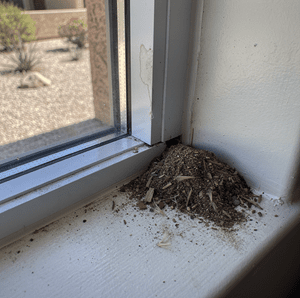
A small pile that looks like sawdust under a window frame or beside a baseboard is frass: the material carpenter ants push out of a gallery they are actively cutting into the wood in your home. It's worth reading carefully, because what it's made of, where it sits, and how fresh it looks each answer a different question: whether the gallery behind it is still being worked on, and whether it's the only one in the structure.
How Does Frass Form?
Carpenter ants don't eat wood the way termites do. They cut through it with their mandibles to open living and nesting space, working along the grain and breaking it into small, ragged fragments rather than digesting it. Once a gallery is open, the colony still has to clear the debris out or the space fills up, so workers carry the loose material to a small opening in the gallery wall and push it through. That opening stays small, just wide enough for a single ant to pass debris through, which is why frass collects in one place instead of scattering across a wide area. What collects outside that opening, or falls below it, is the frass pile you find. As long as the gallery stays active, the ants keep clearing fresh material through that same opening, so an established pile can keep growing for as long as the work continues.
What's in the Pile Besides Wood?
Look closely at a pile, and you'll find more than wood. Ants clear other debris from a gallery along with the fragments they cut: broken pieces of exoskeleton from ants that died inside, fragments of shed wings from an earlier swarm, and, where a gallery runs through a wall cavity, bits of insulation the ants passed through on the way to open wood. None of that material is food or a building supply for the colony; it's simply cleared out so the space stays usable, and the same opening the ants use to push out wood fragments carries the rest along too. Because the mix looks different from plain sawdust once you know what to check for, that difference is what sets carpenter ant frass apart from three look-alikes people mistake it for.
| Material | Texture | What's Mixed In | Typical Location |
|---|---|---|---|
| Carpenter ant frass | Coarse, ragged fragments that crumble apart easily | Wood bits plus insect parts, wing fragments, and sometimes insulation | Below or beside a small opening in a wall void, window frame, door frame, or sill |
| Subterranean termite signs | No loose pile at all | Mud tubes running up a foundation wall or pier; galleries packed solid with mud and soil | Along foundation walls, over sill plates, or inside wood the termites have hollowed and refilled |
| Carpenter bee sawdust | Coarse sawdust, no insect parts mixed in | Wood shavings, and staining can streak the wood below the hole | Directly beneath a round, drilled entry hole in exposed wood such as a fascia board or deck rail |
| Ordinary sawdust or insulation debris | Uniform if cut by a saw; fibrous and loose if it's insulation | Matches whatever material produced it, no insect parts | Near recent construction or repair work, vents, or attic and crawlspace access points |
Where Does Frass Appear, and What Does That Say About the Nest?
Frass appears wherever the ants are currently clearing debris, so its location marks that specific opening rather than the full extent of the gallery behind it. Window frames and door frames are common spots because the seal around them lets moisture work into the wood over years, and that moisture-softened wood is easier for a colony to open than drier framing. Sill plates near the foundation and any wood that has taken on damp for another reason- a slow roof leak, condensation around a pipe, a plumbing penetration that was never sealed tight- follow the same pattern. Exterior wall insulation is a related case: ants can nest in foam insulation itself, not only tunnel through it to reach open wood beyond, so an opening can appear on an inside wall far from any visible moisture source at all. Because the opening is where debris exits, not where the gallery ends, a single pile at one door frame doesn't rule out a second, unconnected opening elsewhere in the same wall.
Is the Pile Fresh or Old?
Fresh frass matches the color of the wood currently being cut and sits loose rather than packed down or settled. Clear a spot, and if new material shows up there again, the gallery behind it is still being worked. An old pile has sat undisturbed long enough to pick up dust, get pressed flat, or gray out from light and air; it can mark a gallery the colony isn't expanding right now, either because the ants moved to a different opening or because the season has slowed things down.
That seasonal slowdown reads differently depending on where the gallery sits. A gallery inside a heated wall keeps warmth through the cold months, so a colony working there can keep clearing debris straight through winter, and a pile that keeps growing well into the cold season still points to current activity. A gallery in unheated framing, an outbuilding wall, or lumber outside the heated part of the structure follows the outdoor temperature instead and goes quiet once it drops, so an old, undisturbed pile found deep in winter there marks a gallery the colony isn't using right now rather than one that's still being dug.
Sweep one pile down to bare wood and leave a second untouched for the technician. A spot that fills back in is still being worked; one that stays clean through warm weather has gone quiet for now, not necessarily dead.
Why Doesn't One Pile Mark the Whole Nest?
A carpenter ant colony can run more than one gallery at a time, connected by trails the workers travel rather than by tunnels cut through the wood itself. The original nest can sit in an older piece of wood or damp ground outside the structure, a stump, a fence post, or ground contact somewhere on the property, and once it's established, workers carry brood out to start satellite galleries in drier, sound wood closer to whatever food and moisture drew them in. Each satellite clears its own frass independently, so a pile under a window and another inside a closet ceiling doesn't necessarily point to two colonies. It can just as easily be one colony running two galleries some distance apart. A trail running from a pile to the outdoors links that gallery to a parent nest outside, which is why the colony, not the one gallery, is what treatment has to reach.
How Does Treatment Use What Frass Shows?
None of this means a technician needs to trace every pile back to a fully exposed gallery before treating the problem. A whole-structure approach uses each frass location, along with sounds and moisture readings from other spots, as one data point among several, then treats the structure as a whole rather than chasing each opening to a dead end and cutting it open to confirm what's inside. Several piles found across different rooms simply widen that picture: they show the technician which openings the colony has been using and which shapes the treatment takes, without requiring a single wall to come apart. It doesn't have to be traced through the wall for the plan to work.
Cutting into a wall yourself to chase a gallery risks slicing through wiring, plumbing, or a structural framing member, and the gallery can run well away from the spot you cut toward.
Frequently Asked Questions
Does sweeping up a frass pile stop the ants from digging?
No. Clearing it away changes what you see, not what the colony is doing. The gallery behind it keeps being worked until the colony itself is addressed.
Why do you sometimes find frass without ever seeing an ant?
The ants doing the digging work inside the wood and can forage after dark, so a pile can keep growing without you ever catching one crossing an open surface in daylight.
What does the wood look like once carpenter ants have tunneled through it?
Carpenter ant galleries follow the wood's softer grain lines, so the tunnels come out smooth and cleanly hollowed rather than rough or splintered on the inside.
Can firewood bring a colony indoors?
It can. Split firewood cut from a hollow or damp log can hold a whole nest, and a stack stored inside or against the house gives the colony a warm place to keep working, so frass near a woodpile may have nothing to do with the walls.
Do winged ants near a frass pile mean the colony is spreading fast?
Not on its own. Winged ants come from a colony that has reached maturity, and a mature colony sends out a flight every year, so they tell you the colony's age rather than how fast the gallery beside them is growing. Seeing them inside the house does mean the colony, or a satellite holding its brood, is inside the structure.
Can the pile show whether the gallery is raising young?
It can. Pale fragments of cocoon or larval casing mixed into a pile mean that brood is being raised in that gallery, which marks it as a nest rather than just a passage being cut.
Point out the frass piles you found — a whole-structure evaluation reads them along with sound and moisture checks and treats the colony without opening a single wall. Green Pest Control serves the Farmington Valley. Call (860) 658-2266.